Showing posts with label Potala. Show all posts

Monday, March 10, 2008

Tibet Uprising Day


This feels like the coldest day yet—I’ve been in Tibet for nearly a week. Maybe it just seems colder because I had the coldest room yet; maybe I should try harder to turn up the remote-control heater, since like the one in Shigatse it’s stuck on 30 degrees centigrade, whatever that means. No matter how cold my room seems, it’s a lot colder outside my room than in it! I could see my breath in the hotel roof restaurant. I’m sure Tibetans are less sensitive to cold than I am—even most Americans are less sensitive to cold than I am. In the restaurant, I had three cups of tea (they’re tiny cups), and when I was done eating and pushed away my plate, I put my glove back on my right band before I continued drinking tea.

2
Wow—what a morning! It’s now 1:15 pm, and I’m at the Tangyeling Café, which rather caters to Westerners. Not only is the menu multilingual and big, but it even has Indian food, Mexican food (or something like it) and stuff like pizza. Too bad I didn’t find the place when I wandered into the noodle joint my first full day in Lhasa. Here I ordered Indian food that’s hopefully authentic (except it doesn’t have to be as spicy). The café also has really nice ambiance. It has elephant-patterned cloth placemats, pictures and banners and little prayer wheels on the walls and big glass windows. There’s recorded music, and it’s Western, which reminds me of Mc’llo’s in Dharamsala, although it’s much quieter here.

This morning I walked the three long blocks to the Potala, circumambulated once, bought a disposable camera at a little camera shop, dodged the traffic (I swear I can hear Paul McCartney singing “Let it Be”) to the park across from the Potala, took some photos—including two of my stuffed toy owl Dewey in front of the Potala. I got back across the street and circumambulated the Potala three times straight.
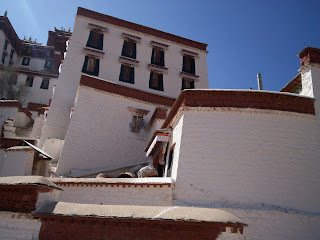


After I took pictures of Dewey and the Potala from concrete steps descending into a pond, I headed further toward the left to the big bland square that has a monument to the Chinese invasion of Tibet (still absurdly called “The Peaceful Liberation of Tibet”). I got to the center of the square and stood there very visible, held up the little camera, and took a full frontal photo of the Potala. I heard someone yell something, and I turned. It looked like a Chinese cop in a blue uniform was looking at me, and he yelled again. There was some distance between us, and since I was wearing Tibetan clothing, he may have mistaken me for a Tibetan. I looked at him for a beat, and he was silent, so I shrugged, turned around, and took another picture of the Potala. Nothing happened.
I turned and moved further up the square, to get a closer look at the Invasion monument and to take a picture of it, when I noticed that a soldier in a green uniform stood on the steps at the monument, so I decided not to take a picture after all. I didn’t want to push my luck that far, although I’d been drinking Tibetan holy water. I got a little closer to look at the monument, turned and got a much more satisfying look at the Dalai Lama’s palace. I headed back the way I came, with the intention of taking the dangerous crosswalk again. But first I stopped amid the bare trees and took a picture of the Invasion monument from a hopefully safer distance. I also took a little walk across a bridge and circumambulated a café in Tibetan style—bright and colorfully painted—and then I went back to continue circumambulating the palace.

My lunch at Tangeyling consists of vegetable korma (with broccoli! I had broccoli withdraw), yoghurt with bits of cucumber, naan, and masala chai. It was like I was back in Varanasi. Americans sat and had a lively conversation at the next table, along with probably the only blonde baby in Tibet. That must look really weird to the locals.

3
I wrote the following in the evening, by the light coming in through the hotel room window, since the power was out all afternoon, evening, and night. I would have sent this as soon as I got to Kathmandu, but the power is highly unreliable there.

I was in Lhasa on Tibet Uprising Day

This morning as I equanimously lived in the present moment, doing a walking meditation around the Potala and occasionally spinning prayer wheels while I observed the pilgrims around me, I didn’t think much about the fact that today was Tibet Uprising Day. At the back wall below the Potala, I was startled by the sight of a white police vehicle something like an extra large golf cart filled with six cops in full uniform.

After one walk around the palace, I crossed the street and stood in the center of the square, where I took a dead center picture of the Potala. Strangely, a cop seemed to yell at me from some distance, but I didn’t understand what he said. I looked at him for a moment, but he stood perfectly still, so I shrugged, turned around, and took another picture, to see what he would do. He didn’t do anything. Since I wore Tibetan clothing, perhaps he had at first mistaken me for a Tibetan. Later, I had circumambulated three more times and was ready to head out toward the Jokhang Temple, when I noticed numerous blue uniforms standing around the street corner, so I jaywalked and moved on.

Around 4:30, I returned to the Barkhor and began a walking meditation around the Jokhang Temple. I was in basically the same mental state I had been in while circumambulating the Potala. In the past week, I’ve walked around the Jokhang and stood on its roof, and this was the first time I noticed police standing around the Barkhor, the circumambulation route for the Jokhang. That reminded me what day it was, but I remained equanimous and continued my walking meditation while out of curiosity keeping an eye out for cops.

Some of the police wore navy blue uniforms: badges, caps, and all, like airline pilots. At first, those were the only police I noticed. I decided to circumambulate six times rather than only three. Next time around, I noticed not only several uniforms but also cops wearing navy blue, with navy blue windbreakers. Both kinds of police either stood around watching the steadily moving crowd or sat on stools or benches around the Barkhor. I saw more cops than you can shake a prayer wheel at.

After that, I started noticing what I suspected were undercover cops, and one of them said, “Hello!” to me like anyone else. I am so sick of that word, but I smiled faintly and said, “Hi.” (Incidentally, I only saw three other Westerners the whole time I was circumambulating, and they all looked to be cheerfully shopping.)

When I had walked around six times, I was about to depart through the paved square in front of the Jokhang, when a police siren jolted me out of my walking meditation. A small police van drove onto the square, which is normally reserved only for pedestrians. Like many others, I stopped to gawk, as I noticed two white cop cars and a huge crowd of police in navy blue uniforms standing, many of them forming a wall facing the temple. Brimming with curiosity, I joined the growing crowd, in which I was the only Westerner. This would have been a great time to be fluent in Tibetan, so that I could have understood what people around me said. To the right was a white vehicle and a large number of people gathered; many blocked my view, but it looked like most of that crowd was young, perhaps teenagers, and they were just standing around staring. In front of them stood cops in full uniform.

My first thought was that a demonstration had begun, even though I had thought that nobody would demonstrate unless they were suicidal. But as I observed the crowd of cops in the center, most of whom from what I could see formed a line, I thought maybe they were attempting to incite the crowd to riot so that they’d have an excuse to get ugly with the crowd. Finally, I came to the much more likely conclusion that this was all a power-tripping display.

Twice while I was part of this gawking crowd, a cop approached the cluster of people around me and yelled something while holding up his arms as if to push the people in front, and the crowd started to back away and disperse, but other people walked up and took the place of those who walked away. I finally decided that standing around and gawking like this was silly, and I continued circumambulating the temple and observing the police.

I have to admit that at this stage I was no longer feeling equanimous and was more interested in observing the police than in mindfully walking. Cops still stood or sat here and there around the Barkhor. Walking around the left front side of the Jokhang, I saw a cop standing on a wooden bench and holding onto the roof of a merchant’s booth. Eventually I heard a siren again, but this time I was not in front of the temple but rather surrounded by booths and shops. A white police van was moving toward the crowd, counterclockwise, same as the golf cart-like vehicle I had seen while circumambulating the Potala. I have no doubt that this is deliberate, since Buddhists traditionally circumambulate temples clockwise. We all stepped out of the way of the police van and gawked. I kept looking back at the van, and it turned around behind me.

On another round, I saw a couple of young monks and maybe two other people standing in front of a wide and ornate gateway, like the driveways to hotel courtyards in Lhasa. I stopped next to the monks and was quite astonished at what I saw. On the other side of the gateway, two white vehicles were parked with their right sides facing the entrance. A couple of little kids in pale blue school uniforms stood in front of the headlights, and next to them stood a military officer in a green uniform. Facing the children and the officer were at least four rows of green-clad soldiers, all squatting close to the ground, as if frozen in that position, and wearing helmets like motorcycle helmets but apparently used for riot gear. This was too bizarre. After gawking with my mouth hanging open, I looked up in search of sign over the gateway and soon spotted a little square one overhead. It said “Police Station” in three languages.

I circumambulated a total of twelve times, not stopping till it was about seven in the evening and merchants had begun to take down their merchandise from the booths. I truly did not expect a demonstration to take place.

I have a theory that the real reason the power is out is that it’s Tibet Uprising Day—like the Chinese authorities did this on purpose. Maybe the lights will be out till midnight. I’m glad the heater works even though it runs on electricity—it probably has a different connection, I don’t know. There’s a light on in the hallway—I can see it from under the door—and there’s some sort of big room facing the courtyard and with lots of shelves—the lights are on in there. It’s now 9:06 pm.

4
Who cares if the lights don’t work: for once, I had a hot shower! It’s probably because nobody else is crazy enough to take a shower in the dark. I had the flashlight on and I was very careful about not slipping. Now I’m going to bed; I look forward to snuggling under the covers.

Chant softly and carry a big prayer wheel.

Sometimes a prayer wheel is just a prayer wheel. Gee, I wonder if guys and prayer wheels in Tibet are like guys and cars in America. The bigger the prayer wheel…never mind.

Thursday, March 6, 2008

The Dalai Lama's Palace


It’s evening and I just munched on dried fruit and hazelnuts that I packed….but before eating I checked all my paperwork, and it looks suspiciously like I don’t actually have a reservation for a flight at 10:40 am on March 11. Could this be true?! It looks suspiciously like I’ll promptly get to the China Airways website and hopefully make a reservation. Eek—I’m feeling uneasy about this situation.

It is time that I describe the visit to the Potala, which incidentally is named after the Potalaka, rocky mountain that legend has it the bodhisattva of compassion lives on, whether you call that bodhisattva Avalokiteshvara, Chenrezig, Quan Yin, or Kannon.

When we entered the Potala and were ascending a flight of steps, where one look at a window—very deep, like the walls must be about two feet thick—and there’s a wooden frame with no glass. I kind of doubt traditional Tibetan windows used glass—they can always close the shutters, and this isn’t mosquito country. However, it’s such a cold climate, and they have dust storms, so you’d think they’d have windows.

Anyway, on the steps, a group of three little novice monks giggled at me. They had to be younger than sixteen—like about eight or ten—but I’m thinking parents probably get them dressed up as monks in anticipation of their becoming monks at sixteen. No doubt the Chinese government doesn’t mind if this deceives tourists.

There was much climbing of stairs and you couldn’t take pictures in most places, though there were a couple places I did take pictures before noticing the sign with the No Photos symbol on it—a red circle with a line through it, in front of a black camera. This is kind of scary, since there were green uniformed Chinese soldiers all over the place. In any case, we were not at the very top roof, since it has become off limits, but we were on a roof, an area where I took some pictures of the breathtaking view. It’s usually fine to take pictures outdoors but not in. On that one occasion, a boy in a green uniform objected.

The Potala has a large courtyard where operas used to be performed with dancers wearing masks and colorful brocade costumes. High up on a balcony the Dalai Lama used to watch through a sheen red curtain. His living quarters—consisting of audience rooms, study room, libraries, meditation room and bedroom—was high up and the top of a tall and formidable whitewashed structure facing the courtyard. From the courtyard, I looked up and imagined the young Dalai Lama up there, looking down upon the courtyard. Oddly, the courtyard reminded me of the courtyard at Neuschwanstein Castle, which is a Germanic fairy tale castle King Ludwig II had built in the nineteenth century and therefore from a very different place and culture than the Potala.

We did go up and see some of the Dalai Lama’s rooms, though his bedroom is behind a closed door; presumably it still has the same furnishings as when he lived there. The “Watching room” as the balcony is called, is connected to the Audience Chamber, and it has a bright red and ornately carved stepping stool that the Dalai Lama and anyone else used in order to enter the Waiting Room. The room otherwise has the usual sumptuous brocade banners and draperies, in addition to a yellow brocade-draped wooden throne to the left, along the same wall as the stepping stool. There are long cushy-looking benches covered with patterned red, white, and yellow rugs, and some brightly painted tables in front of them.

The various Dalai Lamas didn’t all use the exact same rooms. Different Dalai Lamas had different suites, not entirely surprising given how big the place is. The seventh Dalai Lama had his own little meditation room in which a couple of the walls were mostly glass, with some red- and gold-painted carved wood around the glass. In the room, along the short wall on the right, is his meditation bench, and above it hangs a thangka. Along the long back wall is a cabinet containing gold statues, and the wall facing the bench is covered with brocade draperies.
I experienced sensory overload on a large scale at the Potala and now don’t know quite where to take this next. Oh, yes, we entered a huge prayer hall that doesn’t have the rows of red mattresses you usually see, because as my guide pointed out, “The Potala is now like a museum.” This prayer hall is on display for tourists and is no longer functional, so no monks sit on red benches to chant or play music.

I’m not sure—I think it was a different prayer hall, because I remember a bunch of people were around, but at one point I saw a monk on a bench working on something, and right behind him was a grey and orange cat,. The cat got up and scurried across the path and disappeared—clearly it wasn’t crazy about having so many people around.

We explored many rooms that contained rows and rows of gold statues, in some cases very large ones, bigger than life-size. One enormous tall-ceilinged room contained huge gold stupas covered with jewels; these were the tombs of the Dalai Lamas. Mixed in with the stupas were gold statues and little gold three-dimensional mandalas. When you see photos of the Potala’s façade, the gold roofs mark the location of the Dalai Lamas’ tombs.

At some point, we passed a closed red door a couple feet from a series of five closed red doors in a row, with the usual big round knockers; these were doors to the fifth Dalai Lama’s tomb, which are only opened on Losar, the Tibetan New Year, when countless Tibetans line up to go through the Potala. A long line of pilgrims, whom Gyantzing explained all come from the same village, entered the corridor at about the same time we did. I watched as a couple people stepped out of the line in order to peak through the red double doors that were open a crack. One guy followed them and actually pushed the door slightly more open. Several pilgrims were excited by this and moved toward the door; they all came across as simple and harmless country people.

The pilgrim’s overzealous curiosity inspired the ire of an authority figure, a guy in plain clothes, who marched up to the crowd and shooed them away from the door. He was followed by a mean boy in a green uniform who barked at the crowd and ushered them forward, and even took off a glove and slapped a pilgrim’s shoulder with it. Although that was nothing compared to the torture that I’ve read Tibetans experience, it was still shocking enough to leave me staring with my mouth hanging open. I rather suspect sheer power-tripping malice is the primary reason the authorities don’t want pilgrims to enter certain parts of the Potala, including the very top of the roof. I can understand not wanting people to take photos because the camera flash over time damages artwork.

Finally, we entered the fifth Dalai Lama’s tomb through a different door. The statues were enormous—the usual bodhisattvas and Shakyamuni statues. The stupa itself is covered with ornament and contains the fifth Dalai Lama’s ashes and relics. It was absolutely enormous, like a stupa that you expect to see outdoors, but it was gold encrusted with jewels rather than made of whitewashed earth. Typical Tibetan style, the big bulbous part had a curved window with a very old statue behind it, and another and much smaller Buddha statue sat in a niche in the base.

At some point, we passed through a corridor with, on our left, a glass-walled room with excessively long cabinets containing Buddhist statues not only from Tibet but from several countries, including Nepal, India, and Thailand. One of the cabinets contained a bunch of little reliquary stupas from Thailand. Most of the statues in this room were small, like those anyone might have at home. Some were six hundred years old.

We walked down a dark corridor, and around a corner, on the left, was a meditation cave that belonged to an early Dalai Lama—I’m tempted to say the first, but more likely the fifth or seventh. It had statues—big statues—of Tsongkapa and his Chinese and Nepalese wives, the two princesses responsible for bringing Buddhism to Tibet. The walls were dark grey and, since it was a cave, uneven and bumpy. The room also housed various bodhisattvas, such as Manjushri. At some point, the room was (oddly) used as a kitchen, and there’s a circular metal stove to the right, in front of the statues. The cooks had thought it was auspicious to cook there.

When we stepped outdoors into the sunlight, we were at the back of the Potala and had many stairs to gradually climb down. The stairs were white and fortunately included a low wall to the right, low enough that you could rest your arm on it and admire the scenery. The walls of this part of the Potala were white. From the stairs, I occasionally stopped to admire the view and usually took a picture. The sky was a vast and extremely bright blue. I could hear surreal music that sounded rather like New Age music sung by a woman, and I thought it added a dreaminess to the atmosphere.

I asked, “Is there a concert?” Gyantzing said, “It’s music for people who are exercising.”


I looked down below and could see a park in which there were indeed people exercising, and at least one of them was spinning a large strange white disk. A few feet further away, I noticed a lake, and in the center of it was an island with a small square temple with an elaborate curving roof. Gyantzing explained that this was the Naga Temple in Lukhang Lake, which is inside Lukhang Park and behind the Potala. The island struck me as a very appropriate location for a Naga Temple, since nagas are snake deities.

2
We parted at the hotel for a lunch break. From the hotel, I went to the little shop that sells bottled water, and I bought four more bottles (two of which I’ve already finished—it’s 8:25 am as I’m writing this). I took the bottles, along with the bag of postcards and a little book that I picked up at the Potala, up to my hotel room and dropped some stuff off. I also removed my extra shirt and used the bathroom. I walked from the hotel down the street in the direction of the Jokhang and turned left at the first corner. If I had been headed for the Jokhang, I would have turned right. The narrow street contained many little shops and merchant’s booths and in some cases wagons containing bananas that a merchant was selling, but I wasn’t seeing restaurants.

I saw a woman with a long table on which she served ramen noodles from a heaping huge bowl. In Tibet, Muslim women wear black snoods, and this ramen chef wore such a black lace snood under a sunhat. I walked up to her table and pointed to first the bowl of noodles and then the jar of red chili. She took a little bowl, plopped a heaping serving of noodles into it, then mixed in soy sauce and chili sauce and handed it to me, along with packaged wooden chopsticks. I sat down, opened up the chopsticks and started eating under the fascinated and amused eyes of three children who’d sat down on the bench by me. If nothing else, my eating left-handed may have fascinated them.

The cook wasn’t impressed with my method of scooping up noodles that were covered with the hot sauce and then scooping up dry noodles; she picked up my bowl and mixed the sauce up thoroughly, so that there were no dry noodles. If I had been eating spicy Indian food, I could have eaten from a bowl of bland yogurt and munched on bread or pappadums. Instead, I had nothing to alternate with the hot sauce. I plowed my way through and observed the stinging of my dry lips and sniffed because I didn’t want to blow my nose at the table.

The cook, I observed, opened a canister and placed some strange white stuff into another customer’s bowl of noodles; it was thin, squarish slithers with tiny holes, and I suspected it was fish, since the slick yellow stuff she also chopped up and put in the bowl was fish. She noticed me watching and put two squares of the holey white stuff into my bowl—I ate it, mixing with the noodles and sauce, not wanting to offend but simultaneously appalled that I was probably eating fish for the first time since 1994. While my scruples were damaged, I simultaneously remembered Shantum’s explanation that the Mindfulness Trainings, or five precepts, are guidelines rather than vows. Oh how the mighty have fallen; this is far worse than using the Worst Toilet in India. The strange white stuff had no taste and didn’t gross me out as I would have expected from fish—I was thinking it was either bread or fish, but in hindsight it may have been tofu. Scentless, tasteless, and white; it would be wonderful if it really was tofu. At some point she also noticed the condition of my nose and gave me a piece of toilet paper with which to blow it, which, amused, I did.

While I was eating and making a spectacle of myself (because, incidentally, Lhasa is a place to gawk and be gawked at), I noticed a white juniper stove in which offerings of juniper were burning. I then noticed the colorful and ornate doorway to a small white temple. This was behind the noodle stand. I also noticed, to my amusement, that I was practically next door to a real indoor restaurant that even had its name in English. After I emptied my bowl, except for some red liquid at the bottom, I pulled a fifty yuan bill out of my wallet, and the cook pointed at a ten yuan bill, so I gave her that and she handed me back the fifty. So I think I got a filling meal for a few pennies.

I got up and headed for the little temple, to be accosted by numerous beggars. I wouldn’t give any of them money, since I didn’t want to start a riot, and I kept walking toward the prayer wheels. As a young-looking ragged male beggar approached me on the right, I held my water bottle slightly out, and he took it out of my hand. This struck me as very funny and I suppressed a laugh. The bottle in fact only contained about two inches of water.

I walked the few more steps into the temple and spun the two-foot-tall gold prayer wheels with gusto; the temple contained a concise line of the wheels. I then joined the crowd of pilgrims circumambulating around an Avalokiteshvara shrine that seemed tiny after my morning at the Potala. But it was still quite ornate: the bodhisattva wore a gold crown incrusted with turquoise and coral. I circumambulated three times—this involved being pushed by fervently murmuring pilgrims through a narrow and darkish corridor. I then headed back out and down the street to the hotel, where I used the Internet for half an hour.

Tuesday, March 4, 2008

My Arrival in Lhasa, Tibet


Flying over Tibet, I see tippy-top peaks of snow-capped mountains peaked out of the clouds. Cloud formations included what looked like a panda bear sticking its tongue out. Another cloud resembled someone resting, perhaps a reclining Buddha, and another cloud was too reminiscent of a mushroom cloud. I must have seen the top of Mount Everest, but there were so many mountain tops that I don’t know which one it was.

Germans surrounded me on the plane, and when they spoke English, it was with a British accent. A Tibetan guy across the aisle (I had the window seat) asked the German guy next to me if he’d put a book in his bag. It was a hardcover book and pretty big, and he bought it in India and no doubt it was not a pro-Chinese occupation kind of book. The German guy was dubious about it, since he didn’t want to get in trouble either. He turned to me and asked, “Do you speak English?”
I smiled and said, “Yeah.”
“Yeah. You’re British?”
“No, American,” I admitted. He then explained the situation to me and asked if he should take the book, and I said I wouldn’t do it, just to be safe. I then explained, “If he’s caught, he’d get into worse trouble, though. He could be imprisoned. But you’d still get in trouble.” At the airport near Lhasa, the capital of Tibet, my bags had to all go back through a security check, even though we were arriving rather than departing. This young guy in a green Chinese uniform and wearing clear plastic gloves searched both my carry-ons but not my suitcase. Stuff I got in Dharamsala and that I don’t want the Chinese to see is actually in the suitcase, so I lucked out in that respect—so far, anyway. I guess they’re more concerned about what we bring than what we take to an airport for departure, since this is fascist Chinese-occupied Tibet.

The soldier even flipped through pages in my books and notebooks, probably to see if I brought pictures of the Dalai Lama. I’m so glad I didn’t purchase any such pictures in Dharamsala, after all! I’ll wait and get some when I return to Kathmandu.

What the tall, stern and unsmiling Chinese soldier didn’t do is read the smallish print on the front cover of my spiral bound photocopied edition of the Tibetan Dhammapada: there are lots of words on the cover, and toward the bottom is a paragraph specifying the Dalai Lama’s teachings in Dharamsala and the dates of the teachings. Of course this was all in English, and I suspect that he wouldn’t have understood many of the words on the cover. I don’t think Chinese or Tibetan people speak English as much as people from India and Nepal do, since in those countries it’s taught in school even when they’re little kids. That’s the best way to learn more than one language: start in elementary school; I wish we’d do that in America.

I recall reading that, for whatever reason, China doesn’t allow you to bring more than twenty changes of underwear. When I read about that, I imagined what it could be like when a Chinese authority looks through my suitcase.

“You have too much underwear! You are a member of a splittist faction!” “No, that’s just a rip in the seam.” “Why you have Dalai Lama pictures in your underwear?” “I figured of all the places that would least likely get looked at carefully…”

This is so crazy—I’m in Tibet for real! I’d like to take a picture of a yeti, but I won’t be out in the wild, and I doubt a yeti would be circumambulating the Jokhang Temple.

Gyantzing is my tour guide, a guy. I was hoping for a female tour guide. After this trip, I’ll want a one-way ticket to Herland. I was relieved to leave that mean boy in a green uniform and head toward this big open space devoid of furniture with the one exception of a sort of table on which I had to place my Chinese visa, an eight and a half by eleven inch piece of white paper with black ink and an official-looking red stamp. A middle-aged Tibetan guy in a dark jacket approached me and asked if I’m Susan, and I smiled and said, “Yes!” He gave me a khatta, a white Tibetan greeting scarf that’s sheen and printed with auspicious Buddhist symbols. It has a very long silky fringe on each end, and the fringe tangles with everything.

Writing in the minivan while riding from the airport, I took notes in a horrible scrawl, while Gyantzing gave me information:
The airport is at 3600 meters above sea level, and Lhasa is at 3700 meters above sea level. All I know about meters is they’re approximately four feet. I didn’t do the math; I just know it’s big numbers.
The river near the airport is the Brahmaputra, and it’s winding like turquoise arteries. From Mount Kailash to India is 60 kilometers. The Yellow Valley is sandy with short, spiky brown and red plants.
Barley, wheat, and peas are the main crops. I know they can grow potatoes and other root vegetables, though, and they’re actually capable of growing quite a number of vegetables and flowers during a couple of summer months, at least on the plateau. Nowadays there are greenhouses, but oddly they looked empty as we rode past them from the airport. It seems to me like this would be a great time of year to put the greenhouses to use.
Lhasa Gytsu is the central river, and it goes to northern Tibet. ( I wouldn't be a bit surprised if I totally misspelled that.)

Twenty percent of Tibetan males were monks, and two percent of Tibetan women were nuns, before the Cultural Revolution. Or to be more accurate, this was before about 1959, since the Chinese had already invaded and done a great deal of harm before the Cultural Revolution and kicked plenty of monks and nuns out of their monastic lifestyle. However, the tour guide isn’t supposed to say that: the official Chinese bull shit propaganda story is that the invasion was “the Peaceful Liberation of Tibet” (yeah, just like Georgie Porgy and his minion’s invasion of Afghanistan and Iraq were “Peaceful Liberations”) and it’s absolutely verboten to point out that the invasion was in fact very violent and oppressive, not a peaceful liberation at all. Not to mention that buildings like monasteries were bombed; monks and nuns raped and murdered, that sort of thing. Peaceful liberation, indeed.

400 nuns—biggest number in Tibet—on mountain. 600,000 = population of Lhasa, 40% Tibetan. New buildings are coming up in Chinese style. Tall glass skyscrapers, I notice. China has certainly lifted its leg and pissed on Tibet.

I see on the river reddish brown ducks with pale yellow heads, black-tipped wings. We passed greenhouses, where people grow tomatoes, cucumbers, etc, and a group of people planting trees with a cart loaded with branches. We passed Western-looking cows and sheep. I’m kind of surprised that the cows aren’t more like Indian cows.

We passed an 11th century monastery, Ballendesh, built in typical Tibetan style, whitewashed with slanting walls. Pretty. Cremated, ashes in stupa—brought ashes back in 1960’s (I’m not sure if this comment refers to an abbot or to the monks of that monastery in general or not—too bad my notes weren’t more detailed). We came to a mountain with carved and painted Buddhas. Around the time of the invasion or the Cultural Revolution, there was a request that the central government (as in Beijing) not destroy the monastery, so here it stands. (We were still south of Lhasa while I scribbled these notes, while the tour guide was speaking in the jeep.)

The military base, a big tall scary building a few minutes down the road from the old monastery, is three years old. I looked up at the looming rectangle, a very modern building, and thought: That’s a sign that you’re in an oppressive fascist police state. It’s such a power-tripping symbol to have a military base right there, on the outskirts of Lhasa. It disgusts me but doesn’t really surprise me. I seem some green military vehicles in front of the building, around which is a fence with a gate where a stiff green-clad soldier stands. He looks like he’s frozen in place; he may as well be an android rather than a person.

We stopped to see the beautiful, bright Buddha paintings on a mountain, and the ducks on the lake across the road were talkative in and at the edge of the snakelike winding little bits of river. Before we walked up to the mountain and looked at the big bright Buddha, we went through a colorful gate painted in Tibetan symbols, and we stopped at a juniper stove. It’s whitewashed and probably made of earth, and it’s shaped rather like a vase or like a Tibetan stupa, with curved sides and a curved aperture where the juniper is placed. Inside the aperture, the surface is burnt black and has remnants of the plant, and a little bit of smoke still issues out. I’ve seen these many times in photos of Tibetan architecture, and I could tell they were stoves, but I never knew exactly what they were. They’re located in front of all monasteries and temples, and they are used for burning offerings of juniper every morning. I hope they grow plenty of juniper bushes nearby.

The Buddha is indeed huge and painted and slightly carved on the mountainside. It’s low enough that the artist or artists could have been standing on the ground while making it, rather than standing on scaffolding. It’s not smooth and sophisticated but rather has the rough texture of the rocky mountain and has a folk art look to it. Colorful deities, smaller than the Buddha, are painted on the mountain, and I recognize Green Tara, a Goddess of compassion who has one foot down from her lotus throne, like she’s about to get down and help people out. I wish she’d come help me, but I have to help myself.

A few yards past the big Buddha mountain, we passed newly-built summer houses. Although the houses have Tibetan-style murals, the walls are filled with very large greenish glass windows; they are deserted little vacation houses presumably for Han Chinese invaders. They consist of modern architecture despite the murals, and the architect has made no attempt at imitating traditional Tibetan architecture; the little houses look like they might only have one room, maybe a little more than that, and they have peaked roofs. Given what the climate is like, I don’t think people would stay in them for more than a couple months. Would they really enjoy it?


I see plenty of modern versions of Tibetan houses. They have garage doors like Indian and Nepalese buildings but also ornate red Tibetan doors. They have grey walls made of what looks like big stone or cement blocks. They can have large front picture windows, probably for the living room, and they also have plenty of other windows, with glass. Traditional Tibetan windows didn’t have glass but had shutters—given the climate, I’m thinking you’d have to be bundled up all the time, even in the house. Of course, the Tibetan beer chang would warm people up, as would hot food and a fire.

We came to traffic police, who are Chinese in fancy blue uniforms, before we passed bulldozed (or more likely bombed) and graffiti-decorated older Tibetan houses. If they were destroyed in the fifties or sixties, I’m surprised nobody’s cleared away the evidence and instead has left these reminders to inspire resentment and to perhaps inspire some Tibetans to be suspicious of the official Chinese version of their history. I’ve read that Tibetans living in Tibet aren’t getting the real story, and this is not surprising; though if they have parents or grandparents around who remember what really happened, then I suspect they learn from them.

We passed under the new railroad and saw the station in the distance. We passed the notorious train station, which mimics traditional Tibetan monastic architecture and was completed in 2006. I’ve read that global warming means the permafrost is melting, and this will make the train tracks sink and crumble in a short time. Really smart thinking. But of course, the Chinese are in denial about so many things. I’ve also read that while the official story is that the railroad is good for Tibet and that building it gave many Tibetans jobs, the truth is that the better jobs were given to Chinese and that Tibetans had the worse and lower-paying jobs on the railroad. And of course it also means that all the more Han Chinese can move into Tibet, as if there aren’t enough. They don’t even have the lungs for this climate—I can’t think they’d be all that much at home.

On the left we passed a cement factory, which according to Gyantzing is one of the first factories that the Chinese built in Tibet, in the 1960’s, causing the worst pollution in Tibet.
Also on the left, after we’ve entered Lhasa, we passed Drepung Monastery. It is on a mountainside beyond shops and looms up looking quite large and impressive, all whitewashed walls slanting inward so that the base of the wall is wider than the top, just in all traditional Tibetan architecture, and the monastery has the obligatory black-framed windows. Sera Monastery is in Lhasa and Ganden, which houses the yellow-hat sect, is in Gyantse. It dates to the 11th-12th centuries, 14th century. The last sect only dates to the seventeenth century and is a reformist sect thanks to the fifth Dalai Lama. He got other orders to change into the Yellow Hat (Gelugpa)—most monasteries in Tibet are now yellow-hat. The second through the fourteenth Dalai Lamas had their education in this monastery, Drepung. It’s a big and special place. I’ve had the impression that lately the reason there are so many more Gelugpa monks and nuns is because of the Fourteenth Dalai Lama’s charisma, but it sounds like it predates him.

We’ve passed countless Chinese shops on the outskirts of Lhasa. I look at the signs over the roll-up doors and see scarcely any Tibetan script, all Chinese. Yes, I mentioned roll-up doors; I didn’t expect Tibet to have the same sort of entrances to shops that India and Nepal have, but there it is. I’m guessing that China also has shop doors that look to Westerners like garage doors, because under the circumstances Tibet is much more influenced by China than by India, although Buddhism came from India to Tibet and therefore in the past India had a huge influence on Tibetan culture. We stopped at the Bank of China, a remarkably new-looking building (like so many) but they’re not taking US dollars at this hour, so we’ll go back tomorrow morning to exchange some of my money.

I saw a very skinny and young Chinese woman sitting behind a guy on a motorcycle. She wore tight jeans and a purple jacket, and I noticed that she had tall black boots with spiked heels. I guess it was the boots, plus things I’ve read about modern Lhasa, but I strongly suspected her of being a prostitute sitting behind a customer. The motorcycle was at a wide intersection and zoomed off around a corner to the left. The streets are so wide and clean here, nothing like the narrow, dirty, and chaotic streets in Kathmandu.

As we drove past the towering and impressive Potala Palace, I gasped and gawked and the tour guide told me a few things about it. The Potala has thirteen stories and a thousand rooms. On the façade different sections are painted different colors: red, white, or yellow. The red rooms are the Dalai Lama’s and for politics. The white rooms are for the monastery. In other words, the Potala has a color-coded façade. The yellow section is a courtyard between the special white section, which contains among other things the Dalai Lama’s rooms, and the red. This isn’t tourist season, so we can spend more time in the Potala; normally tourists are only allowed one hour in the Potala and it is crowded.

The Potala sits on top of a mountain, the Marpo Ri or Red Hill, and it looms over Lhasa as if it’s giving the Chinese government the finger. I’m not one of those Shangri-la people who think that Tibet has been nonviolent for the past hundred years; I know it has in that time been just another patriarchal country, and according to the history books Tibet has had wars with China and even battles between different sects, different monasteries. Nonetheless, I figure that since the mountains are still standing, the Potala is still standing, and the Jokhang Temple is still standing, Tibet still has some magic.

I don’t think it’s possible to be a radical feminist and be a Shangri-la person, someone who sees Tibet and Tibetans through rose-colored glasses. If you have feminist consciousness, then shortly after you start learning about Tibetan culture it becomes really obvious that it’s male-dominated, and you might also suspect the monastic system of being somewhat power-tripping in general, not just in its contempt for women and nuns.

Actually, the monastic system isn’t all to blame for that, but rather the social structure in general: parents encourage their sons to go to the monastery, which traditionally was where you got the best education. But parents highly discourage their daughters to become nuns and thereby get a comparable education to the boys; they’re encouraged to get married and give birth to children. Even if they do become nuns, they have a tendency to do domestic chores around their parents’ house or for the monks, so that they still don’t get the kind of education and training that monks get. Nuns are not fully ordained bhikkunis and are totally considered subservient to the monks. Also, in Tibetan tradition, monks perform rites and ceremonies for the people, but nuns totally don’t. It’s so misogynist and hateful, and every time I read or think about power-tripping males in Buddhism I find it terribly ironic, given what Buddhist practice is supposed to be all about. Cultivating male ego has no resemblance to cultivating egolessless, quite the contrary. I should perhaps mention that of course my male and androcentric tour guide didn’t mention any of these things; my comments come from many books I’ve read about Tibet and Tibetan Buddhism.

The Yak Hotel, where I’ll be staying, is just down the street from the Potala itself, on the main drag, Beijing Street. It is a very wide and very modern and clean paved street, again in sharp contrast with what I’m accustomed to seeing in India and Nepal. The streets in Lhasa are indeed reminiscent of a Western street, and the steering wheel is on the left side, just like in America. In both India and Nepal, it’s on the right, and traffic goes on the left side of the road.

The Yak Hotel, which I started to mention, is at least two stories tall and has a grey concrete façade. Facing the main drag is a wide doorway into the lobby, and the doors are open and display two door curtains, or whatever they’re called, that are white with blue trim and appliquéd with big blue Buddhist continuous knots; we had seen some for sale at the nunnery in Dharamsala, and Marsha purchased one in the gift shop. To enter the hotel parking lot, we actually drove through a gateway that led to a courtyard where other vehicles are parked. The courtyard is surrounded by tall grey walls that imitate traditional Tibetan architecture but have straight walls rather than the truly traditional ones that slant inwards.

This neighborhood, where my so-called budget hotel is located, is the Old Lhasa neighborhood, where most of the Tibetans live and where the architecture at least pretends to be traditional Tibetan architecture. The street is flanked on both sides with tall, grey stone or concrete block buildings, with black-framed windows and flat roofs. Along each side of the very wide street is a lane for rickshaws that have striped canopies imitating the top horizontal of Buddhist flags or Tibetan banners; that is, the canopies have a nylon ruffle all the way around, striped in red, yellow, and green, but they’re cheap and faded-looking compared to the rich brocades that you would see inside a Tibetan temple.

Before I parted with Gyantzing in the lobby, he gave me a brief run-down on tomorrow morning. For breakfast, there’s a fifth floor rooftop restaurant. At 9:45 I’ll meet with Gyantzing in the lobby.

Most of the hotel staff apparently consists of very young and thin Tibetan women. A skinny girl in a mauve padded nylon jacket took my wheeled suitcase and carried it up a flight of stairs to my room. Also a boy helped out in the room, and between them they introduced me to the heater with its white plastic remote control and someone turned it up for me. I tipped them and looked around the room with a grin.

My hotel room is so not my idea of what you would expect in a budget hotel. This is so much fancier than a Motel 6! The room even has complimentary white terrycloth bathrobes hanging in the closet, and the bathroom contains complementary toothbrush, shampoo, bath gel, and a comb, each in its individual little cardboard box. And on a small table by the windows are a teapot, tea bags, and Chinese-style white porcelain teacups with lids and decorated with a Yak Hotel logo illustrating yaks. There’s a mini bar, but it just has a few beverages—pop in red and white cans like Coca-Cola, Lhasa beer, and four bottles of water; I’ll definitely drink all the water. There’s a Western toilet and bath; I figured in a budget hotel I’d be squatting for both the toilet and a bucket bath. Furthermore, the décor isn’t plain and drab; the room is beautiful—it is brightly painted with Tibetan Buddhist murals, including the Wheel of the Law. The ceiling is also brightly painted with ridges like those in the architecture of Tibetan monasteries. The only thing budget-like that I can figure out is that there’s no elevator. I don’t think there’s room service either, but I’ve never used that anyway.

I am in Tibet! I am so dizzy! I ate some dried fruit and hazelnuts that I brought, and I took the Chinese herbal medicine and an altitude pill. I’ve only been to a dozen countries, but I somehow suspect Tibet is the weirdest country in the world. I hope the aroma of incense and butter lamps will be stronger than the smell of hygienically challenged pilgrims.

I should mention, thanks to a glance back at my scrawled notes, that when we got to the old Tibetan neighborhood, which is called—guess what—the Old Tibetan Neighborhood, there are shops with lettering in both Tibetan and Chinese. Again, the shops have open fronts like in India and Nepal, and when they close for business, they roll down the “garage” door.

2
With altitude sickness and a cold, I went to bed at 8 pm tonight. I just woke from a dream in which I was outdoors with a happy group of people holding hands and dancing around a pine tree… or maybe we danced around a player piano that mostly played automatically but you could push keys and make some music. I was dancing with the Dalai Lama! He was on my left and let me hold his pinky while everyone danced. The dancing style seemed rather more Jewish than Buddhist, like at a Jewish wedding.