Immediately after I got home from a trip to India, Nepal, and Tibet, I turned on my computer, typed up the following eyewitness account, and sent it to the International Campaign for Tibet and various news media. I ultimately also sent it to the president of China and to Amnesty International, and perhaps a few other organizations. The Olympics in China are coming up, and currently the International Campaign for Tibet's website has a letter that you can send to Bush, because he's going to visit Beijing. (I could make a snide remark about how I'm sure someone who's literate will read the letter to him, but I'll refrain.)
Today is March 10, 2008, and I am writing by the light from a hotel room window, since the power is out, as it has been all afternoon, evening, and night. I have spent a week in Tibet, and this is the only day that there has been a power outage, quite unlike Kathmandu, Nepal, where power outages happen at least once a day and last for hours. I suspect that the authorities deliberately turned the electricity off in at least part of Lhasa, just because today is Tibet Uprising Day, when protests against the Chinese occupation are most likely to occur. On this day in 1959, the current Dalai Lama sneaked out of his summer palace, the Norbulingka, and began a long journey to exile in India; two days later, the Chinese bombed the palace and still thought he was inside.
This morning as I equanimously lived in the present moment, practicing my walking meditation around the Potala, the Dalai Lama’s palace which is perched high on a mountain. I occasionally spun big gold prayer wheels set in wooden frames while I observed the pilgrims around me, some of whom greeted me with the words, “Tashe delek,” or “Hello!” I didn’t think much about the fact that today was Tibet Uprising Day. I was the only Westerner in sight, but I wore a Tibetan-style chupa, or dress, like so many of the pilgrims. Some of them wore contemporary clothes, and I saw many women wearing sunhats, but other pilgrims who had traveled far away wore traditional clothing that was often somewhat ragged, and they carried prayer wheels and often had coral and turquoise beads braided in their black or grey hair. I could see different styles of chupas from different Tibetan regions, for pilgrims walked great distances to reach Lhasa, the capital of Tibet. During one of my perambulations, when I reached the back wall below the Potala, I was startled by the sight of a white police vehicle something like an extra large golf cart filled with six cops in formal uniforms as if they had dressed up to join a parade.
I walked around the palace only once before I crossed the street and stood in the center of the drab concrete-paved square, where I took a dead center picture of the Potala, a beautiful sprawling red and white building with flat roofs and Buddhist banners; at the very top, there are ornate pointed gold roofs over the tombs of the Dalai Lamas. Most of the present palace dates to the seventeenth century, and it is all in traditional Tibetan style, with walls slanting inward and with black-framed glass-less windows. The building is thirteen stories high, and earlier on my vacation I had enjoyed a tour and climbed many stairs. I had stood in the courtyard, looked up at the Dalai Lama’s look-out window, and imagined a much younger Fourteenth Dalai Lama looking down upon the courtyard, as he had before he went into exile in India.
Strangely, after my camera snapped a picture of the Potala, a cop seemed to yell at me from some distance, but I didn’t understand what he said. I looked at him for a moment, but he stood perfectly still in the square, so I shrugged, turned around, and took another picture of the Potala, to see what he would do. He didn’t do anything. Since I wore Tibetan clothing, perhaps he had at first mistaken me for a Tibetan. I soon crossed the street and happily circumambulated the Potala three more times. I remained equanimous even when I reached the left side of the building and megaphones blared out music from a shop and advertisements from a cart full of merchandise. I did not feel annoyed when I was at the back of the Potala and could hear pop music blaring from the park that includes the Naga Temple. Under the circumstances, I would have preferred to listen to Tibetan Buddhist monks or nuns chanting.
I was ready to head out toward the Jokhang Temple, when I noticed numerous blue uniforms standing around the street corner, so I jaywalked and moved on. I headed for the vicinity of the Barkhor, an alley or path that circles the Jokhang Temple, the most significant Buddhist temple in Tibet. I had lunch at a café near the temple and went to my hotel room to write in my journal and take a nap.
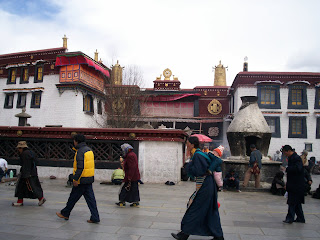
Around 4:30, I returned to the Barkhor and began a walking meditation around the Jokhang Temple. I was in basically the same mental state I had experienced while circumambulating the Potala. So much walking meditation, perhaps combined with the thin air, is enough to put me in a calm, content, and peaceful mood. In the past week, I’ve walked around the Jokhang and stood on its roof, and this was the first time I noticed police standing around the Barkhor, the paved and crowded circumambulation route for the Jokhang, where pilgrims from all over Tibet walk around and around, much as they do around the Potala. Espying the police reminded me what day it was, but I remained equanimous and continued my walking meditation while out of curiosity keeping an eye out for cops.
Some of the police wore navy blue uniforms: badges, caps, and all, like airline pilots. At first, those were the only police I noticed. I decided to circumambulate six times rather than only three. Next time around, I noticed not only several uniforms but also cops wearing navy blue, with navy blue windbreakers. Both kinds of police either stood around watching the steadily moving crowd or sat on stools or benches around the Barkhor. After that, I started noticing what I suspected were undercover cops, and one of them said, “Hello!” to me like anyone else. I am so sick of that word, which almost every Tibetan apparently knows, but I smiled faintly and said, “Hi.” I only saw three other Westerners the whole time I was circumambulating, and they all looked to be cheerfully shopping.
When I had walked around six times, I was about to depart through the large paved square in front of the Jokhang, when a police siren jolted me out of my walking meditation. A small police van drove onto the square, which is normally reserved only for pedestrians. Like many others, I stopped to gawk, as I noticed two white cop cars and a huge crowd of police in navy blue uniforms standing, many of them forming a wall facing the temple. Brimming with curiosity, I joined the growing crowd, in which I was the only Westerner. This would have been a great time to be fluent in Tibetan, so that I could have understood what people around me said. To the right was a white vehicle and a large number of people gathered; many blocked my view, but it looked like most of that crowd was young, perhaps teenagers, and they were just standing around staring. In front of them stood cops in full uniform.
My first thought was that a political demonstration had begun, even though I had assumed that nobody would demonstrate unless they were suicidal. But as I observed the crowd of cops in the center, most of whom from what I could see formed a line, I thought maybe they were attempting to incite the crowd to riot so that they would have an excuse to get ugly with the crowd. Finally, I came to the much more likely conclusion that this was all a power-tripping display. Nonetheless, putting on this display is just the thing that could encourage Tibetans who believe in freedom and who are loyal to the Dalai Lama to put on a political and hopefully nonviolent protest.
Twice while I was part of this gawking crowd, a cop approached the cluster of people around me and yelled something while holding up his arms as if to push the people in front, and the crowd started to back away and disperse, but other people walked up and took the place of those who walked away. I finally decided that standing around and gawking like this was silly, so I turned away and continued circumambulating the temple and observing the police.
I have to admit that at this stage I was feeling rather less equanimous and was more interested in observing the police than in mindfully walking. Cops still stood or sat here and there around the Barkhor. Walking around the left front side of the Jokhang, I saw a cop standing on a wooden bench and holding onto the roof of a merchant’s booth. Eventually I heard a siren again, but this time I was not in front of the temple but rather surrounded by booths and shops behind the temple. A white police van with a blaring siren moved toward the crowd, counterclockwise, same as the golf cart-like vehicle I had seen while circumambulating the Potala. I have no doubt that this is deliberate, since Buddhists traditionally circumambulate temples clockwise. The crowd stepped out of the way of the police van and gawked. I kept looking back at the van, and it turned around behind me. This senseless driving around with a siren when there was no emergency struck me as ridiculous, and again the phrase “power-tripping display” came to my mind.
On another round, I saw a couple of young monks and maybe two other people standing in front of a wide and colorfully painted gateway, like the driveways to hotel courtyards in Lhasa. I stopped next to the monks and was quite astonished at what I saw. On the other side of the gateway, two white vehicles were parked with their right sides facing the entrance. A couple of little kids in pale blue school uniforms stood in front of the headlights, and next to them stood a military officer in a green uniform. Facing the children and the officer were at least four rows of green-clad soldiers, all squatting close to the ground, as if frozen in that position, and wearing helmets like motorcycle helmets but apparently used for riot gear. This was too bizarre! Nobody was rioting, and I had yet to even see a single protester. After gawking with my mouth hanging open, I looked up in search of a sign over the gateway and soon spotted a little square one overhead. It said “Police Station” in three languages.
I circumambulated a total of twelve times, not stopping till it was about seven in the evening and merchants had begun to take down their merchandise from the booths. I truly did not expect a demonstration to take place and therefore decided I had seen enough. I assumed that the rest of the evening would look much the same: the police and soldiers would continue their power-tripping nonsense, while the crowd would merely gawk and keep walking rather than protest or riot.
2
Today is the day after Tibet Uprising Day, and I have returned to Kathmandu, where the power is of course out; if the power were more reliable, I would go to the Cybercafé, type up my eyewitness account, and e-mail it to the International Campaign for Tibet and anyone else. Under the circumstances, I shall have to wait a few days, till I have returned to the United States.
In the morning, I was in the jeep with the driver and my tour guide on the way to the airport. Along the main drag, Beijing Road, we saw many green military trucks and green-clad soldiers, some still wearing riot gear helmets. The guide told me that monks at Drepung Monastery (which we had wandered around earlier in the week) fought with the military, and laymen joined in. The same thing happened at the Jokhang, perhaps only shortly after I left the Barkhor. I said, “I left the Jokhang around seven.” My guide also said that Drepung is now closed to tourists. On the outskirts of Lhasa, a military convoy was coming out of a base and we passed some of the vehicles; I counted at least nine trucks.
At the airport, a friendly guy in a uniform was stamping my passport and asked, “Was this your first visit to China?” I found the question startling, since I wasn’t in China, but I didn’t see any point in arguing and replied in the affirmative. He then asked, “Did you enjoy your first visit to China?”
I said, “Yes, it’s gorgeous! Maybe next time I’ll learn the language first.” I felt slightly ashamed of not arguing, of not righteously correcting him by pointing out that I haven’t visited China yet. But I do not like confrontation and did not know how to articulate such words. I had to be content with writing my eyewitness account and sending it to the media and to such organizations as the International Campaign for Tibet. It was a small bit of activism, but it was much more useful than arguing at the airport.


